
Sustainability is an integral part of the performance promise that STILL makes with each of its products. STILL sees itself as a pioneer in the development of efficient low-emission drive technology, not least thanks to its longstanding tradition of developing electric vehicle technology that meets the specific requirements of its target customer groups, which has been the core element of the business for over 100 years.
Product Development
With uniform standards and global coordination of technical activities to shorten the development times despite a growing variety of product variants, the development approach of KION is geared towards efficiency. Product development projects initiated as needed by the product management team of the KION ITS EMEA Operating Unit are coordinated and overseen by the Group-wide CTO organization. With its products, services, and individual solutions, STILL, as part of KION, aims to make a significant contribution to helping its customers achieve their sustainability targets. Therefore, STILL pursues the goal of integrating sustainability into all phases of the product life cycle – from design and production through to use and end of life – as effectively as possible.
STILL has a clear objective of consistently aligning its portfolio with sustainable battery technologies. The company is also aiming to steadily increase the proportion of components that are fed back into the production process with new product innovations. In 2025, 98.2 percent of STILL trucks sold to customers were electric. To support these measures, the Innovative Product Evolution Process 2 (iPEP 2) of KION provides a comprehensive framework for optimizing product development along the entire value chain. The success of this process is based on its clearly defined roles and process structures, which are supported by integrated project planning. One important aspect here is the flexibility of project managers to adapt the process to specific requirements, such as sustainability targets.
In 2025, a series of updates for selected iPEP2 deliverables was introduced to further improve the structured integration of sustainability aspects into product development. In addition to refining existing processes, “Product Sustainability Alignment” represents a completely new element. The associated developments concern process requirements, evaluation steps, and data flows, so that environmental and circularity aspects are identified early, documented, and consistently managed via the life cycle management system.
Innovation in Production and Products
The commitment of STILL to continuously improving processes and products is also reflected in its manufacturing. One example of more efficient utilization of resources is the mixed production line, where several different truck models are assembled on the same conveyor. As well as providing economic benefits, this production method also requires less production space and thereby reduces the need for raw materials and energy to construct, operate, and maintain the infrastructure. The level of automation in production was also increased in the case of counterbalanced trucks built on the mixed production line, for example through robotic welding. This not only has environmental benefits – by preventing spikes in electricity usage, for example – but it also promotes employee health, as it often means they are no longer directly exposed to welding risks – such as heat source and fumes.
Another example of the commitment of STILL to innovation and sustainable product development is the FM-X iGo, the first automated reach truck of STILL in series production, which won the IFOY Award in the “Mobile Robot” category in 2025 – the thirteenth IFOY Award for STILL. The FM-X iGo embodies the core sustainability principles of STILL: Its lithium-ion technology ensures high energy efficiency and availability, while its ability to seamlessly integrate into existing warehouse layouts and make optimal use of available storage space reduces the need for customer infrastructure expansions and the resource consumption that this entails. Furthermore, its design, which is based on standardized components, supports straightforward maintenance, quick repairs, and facilitates software updates via a digital twin. This extends the product life cycle and reduces material requirements.
In the 2025 reporting year, STILL was also nominated as a finalist for the IFOY Award 2026 in the “Special Vehicle” category for a specially adapted RX 60 electric forklift truck developed in close collaboration with Voß Edelstahlhandel and special vehicle manufacturer Barrus Engineering. The truck was designed so that it can be operated safely and independently by an employee of small stature, without limiting its practicality for other team members. Since standard solutions were not possible for safety reasons and the stilt solution commonly available on the market did not allow full integration into the workflow, STILL developed a customized, electrically height-adjustable driving platform that can be precisely adjusted to the individual operator’s height at the touch of a button and reset to the standard configuration for colleagues of average height. Since its handover in September 2024, the truck has been used daily at the customer’s site and fully integrates the employee into normal warehouse operations. This expands his range of tasks and contributes to a more inclusive working environment. The nomination is an example of how customer-oriented technology can promote accessibility in the intralogistics workplace.
A key highlight of 2024 was the addition of three new frames to the LiftRunner system of STILL. One of these allows a single towing truck to pull six to eight trailers, thereby doubling the towing capacity of the tugger train without the need for more space. This reduces both warehouse traffic and energy consumption. The two other models are designed for automating the “last mile” in intralogistics and feature advanced steering for improved driving stability.
Energy Management
With its “Mission: Zero Emission”, STILL aims to reduce CO2 emissions from its product portfolio to zero. Until then, the company will continue to optimize its existing technology, in order to give its customers a key competitive advantage. It is for this reason that STILL continues working every day to further enhance the efficiency of its products, including the development of smart software solutions such as the STILL Smart Portal, digital fleet management systems, and intelligent charging systems.
STILL vehicles are already among the most energy efficient in their class. The Blue-Q mode further reduces energy consumption by up to 20 percent by automatically switching off unnecessary functions at the touch of a button.
With the introduction of the STILL Smart Portal in 2025, STILL has taken its fleet management to a whole new level and also significantly further developed the energy management of customer fleets. The previous systems STILL FleetManager 4.x and STILL neXXt fleet have been replaced by this central, modular platform, which bundles all relevant information for fleet management into a single digital overview.
While the focus of STILL in fleet management has so far been on general data management and access control for trucks and fleets, the STILL Smart Energy Unit is an additional solution to further promote sustainability in intralogistics.
The STILL Smart Energy Unit is a standalone product for intelligent charger management: It networks stationary chargers via cable, controls charging processes according to demand, and ensures efficient energy distribution, thus avoiding costly power peaks, controlling charging time windows, and transparently mapping the entire charging behavior as well as fleet availability. This enables intelligent control of charging processes, a reduction in energy costs, and optimization of fleet availability. The Charging Control module allows the product to be seamlessly integrated into the STILL Smart Portal.
Smart fleet management is a fundamental requirement in order to remain competitive in the dynamic world of intralogistics. Smart charging is an important component in this process, ensuring availability, flexibility, energy efficiency, and transparent cost control. After all, only those who know when, where, and how much energy is needed and consumed can reliably and proactively plan their charging processes, and thus the availability of their vehicles and the seamless flow of materials, and significantly reduce their carbon footprint.
In addition to the operational energy management tools of STILL, the Smart TCO Advisor was introduced in the reporting year as a newly developed sales application. Based on customer-specific input such as energy costs and shift models, the tool enables sales teams and energy experts to systematically compare forklift, battery, and charger configurations. The results are clearly presented side by side – including energy consumption estimates, CO2 emission comparisons, and total cost of ownership projections – thus forming a sound basis for identifying the optimal electric forklift truck solution for each individual application. Since its initial release in February 2025, the user base has been growing continuously. Access was gradually extended to sales staff and dealers after appropriate training. Further developments and regular updates are planned, including additional features such as load curve analysis and the integration of real-world operating data.
Alternative Fuels and Drive Technologies
The products of STILL play a key role in its customers’ value chains and have a direct impact on its customers’ progress toward their sustainability targets – including climate neutrality. GHG emissions, energy efficiency, efficient use of resources, and the circular economy are therefore key focus areas for STILL in its ongoing efforts to improve its products and solutions. These efforts include: moving toward an all-electric product range, offering a range of different electric drive technologies, increasing energy efficiency wherever possible, developing products that require fewer materials and generate less waste, and sourcing materials that support the creation of closed-loop material cycles.
Over the years, STILL has continued to develop its electric drive technology and, as a result of these efforts, electric forklift trucks with lithium-ion batteries can now achieve load capacities that were previously only possible with powerful diesel or gas-powered models. STILL is committed to developing electric forklifts that can replace their internal combustion counterparts, and in this respect its products have proven extremely successful.
The majority of STILL trucks are equipped with energy-efficient lithium-ion batteries, which offer significant advantages over conventional lead-acid technology in terms of efficiency, service life, and charging performance – helping customers reduce energy consumption and GHG emissions.
Tailor-made and intelligent lithium-ion battery solutions
In 2025, STILL expanded its battery portfolio with a new lithium-ion battery designed for the most common application profiles within intralogistics. Compared with conventional lead-acid technology, it offers a longer service life, higher energy efficiency, lower maintenance requirements, and shorter charging times – characteristics that contribute to reduced energy consumption during the usage phase and fewer battery replacements over the product life cycle. The precision-fit approach ensures that customers receive the energy system that best suits their individual application profile – thus avoiding unnecessary oversizing and the associated resource consumption. This makes lithium-ion technology accessible to a wider range of applications – including lighter single-shift operations that have so far been predominantly powered by lead-acid batteries – and thus supports the gradual transition to more energy-efficient drive technology in the customer base of STILL.
The battery features intelligent thermal management and is manufactured at the STILL site in Hamburg, which enables shorter transport routes and closer coordination between truck, battery, and charging technology. To validate performance under real operating conditions, an extensive field test program was carried out in several countries and climate zones, covering a wide range of forklift types, shift models, and operating environments. The data collected via cloud-based monitoring flows directly into product development decisions.
Refurbishment and Recycling
Minimum requirements for supplier parts and their selection are defined on the basis of the design guidelines and requirements of KION – including binding works standards. These requirements aim to promote the reuse of plastic and rubber components, ensure compatibility with existing recycling systems, and enable the cleanest possible separation of materials at the end of the life cycle.
Furthermore, STILL strengthens the circular economy along the entire product life cycle – through rental and used equipment offers, the refurbishment of industrial trucks and batteries, and the recycling of lithium-ion batteries. For many years, STILL has offered attractive deals on rental and used equipment, which reduce costs for customers and save valuable primary resources. STILL operates refurbishment centers in Bremen (Germany), Poznan (Poland), and Lainate (Italy), where expert teams evaluate the used trucks, conduct in-depth tests on their hydraulic systems and electronics, and classify them based on their condition (bronze, silver, or gold). Depending on this classification, they then fully refurbish the truck using original replacement parts and repaint it. The battery is regenerated, capacity testing is performed, and after some final quality checks, the truck is ready to begin its second life. By offering this refurbishment service, STILL is already making an important contribution to the expansion of the circular economy.
Used equipment is becoming increasingly important, especially from a sustainability perspective, as it enables significant CO2 savings and contributes to improving the respective carbon footprint. The refurbishment and resale of used trucks and batteries offer significant advantages in this regard: They conserve valuable resources and extend the service life of the products.
In the reporting year, STILL was able to successfully reintegrate 30,304 used trucks (number of all used trucks sold, both to end customers and to dealers) into the circular economy in EMEA. At refurbishment sites, such as the group’s own company BlackForxx, the industrial trucks are professionally refurbished and then returned to the market.
STILL also offers its customers the opportunity to rent trucks on a flexible basis, e.g., to cover peak production periods, help with events, or replace trucks that are out of service. This means that resource-saving use through rental solutions is becoming increasingly important for many companies. Modern fleet management enables efficient use – even without owning a fleet.
KION not only produces its own lithium-ion batteries, but also places special emphasis on refurbishment and recycling and the circular approach for Li-ion batteries. Since 2023 KION has maintained a strategic partnership with Li-Cycle Holdings Corp. Li-Cycle was acquired by Glencore Battery Recycling GmbH (GBR) in 2025; however, the partnership will continue unchanged. Non-functional lithium-ion batteries that have been returned to STILL are shredded at GBR, and the valuable raw materials they contain are recovered and reused. In 2025, over 37 metric tons of battery modules, or 447 batteries, were handed over to GBR for recycling. This represents a significant increase compared with 2024, with over 8 metric tons of battery modules or 162 batteries.
This progress was also supported by a web-based application developed and implemented in 2025. Its aim is to connect additional group companies in Europe to the return process and to simplify it. The solution enables standardized, digital processing of the return process, thereby reducing lead times and increasing operational efficiencies. Through this approach, STILL contributes to the promotion of the circular economy while helping reduce the demand for primary raw materials and lower environmental impacts along the value chain.
Old forklifts that have reached the end of their useful life are disposed of in accordance with Directive 2000/53/EC of the European Parliament and Council. In line with this legislation, STILL publishes detailed information about the disposal of its forklift trucks at approved recycling facilities.
Life Cycle Assessments
STILL is committed to promoting sustainability across all life cycle phases of its products and solutions. Products from various series that are representative of the company’s range were analyzed throughout the entire product life cycle, and these analyses showed that the consumption of energy and fuel during the use phase are significant factors in terms of emissions. Based on this, energy efficiency is a priority for the powerful drive technologies of STILL. STILL is committed to developing robust and consistent Life Cycle Assessment (LCA) methodologies to ensure that reliable data is available for informed decision-making throughout the product life cycle.
Cradle-To-Grave Approach
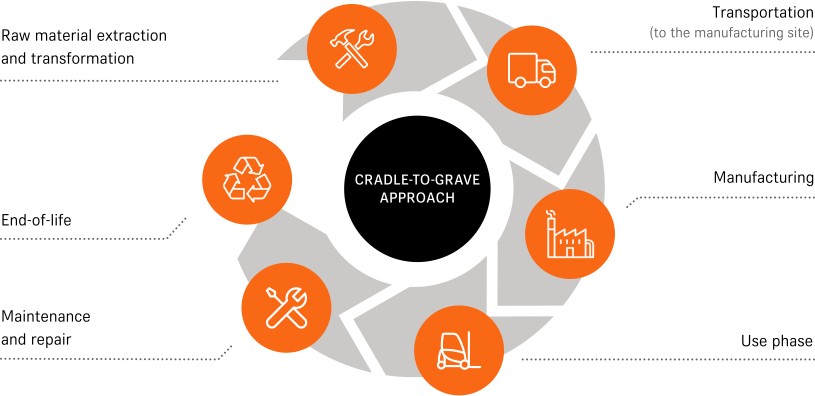
To further improve this process, LCA training was offered in 2024 to a wide range of employees – from managers to technicians – and further expanded in 2025 through the Learning Academy. A structured, multi-stage online program was introduced there, comprising a basic module on the principles of ISO 14040/14044, open to all employees, and an advanced module for technical specialists in product development. The training covered both theoretical and practical aspects to support the internal decision-making processes regarding sustainability, particularly with regard to design assessments, material selection, and component lifetime. Life cycle assessment experts provide practical support to the internal teams and ensure that new findings are incorporated into product development at an early stage.
In 2025, life cycle assessments were also completed for four additional forklift series, further expanding the product coverage of the STILL life cycle assessment program.
The company has set out a timetable specifying which products are to be analyzed over the coming years. Life cycle assessment results will play a significant role in the products and solutions of STILL as the company will be able to incorporate new insights starting in the design phase.
Life cycle assessments are an effective tool for incorporating environmental aspects into the development process of new products and proposing environmentally friendly improvements. They create transparency around the environmental impacts of the products as well as related improvements.